
Glass-Top Stove Burner Won’t Turn Off? It’s Probably a $25 Fix
Step-by-Step Repair Guide by Tampa Bay Appliance Fix
If your glass-top electric range has a burner that stays on no matter where you turn the knob, or one that has stopped responding entirely, you’re likely already dreading the repair bill. Before you call anyone, read this first.
This specific failure is one of the most over-repaired problems we see on stoves in the Tampa Bay area. Technicians replace the burner element. Sometimes they replace the control board. Hundreds of dollars later, the stove still misbehaves, all because nobody looked at the actual cause: a burnt infinite switch that costs $20–$40 and takes about twenty minutes to replace.
Here’s the full diagnosis, step by step, made by technician and based on a real work order in Tampa, FL.
What Is an Infinite Switch?
The infinite switch is the small mechanical component mounted directly behind each burner knob on your control panel. It works by rapidly cycling power on and off to the heating element, which controls temperature by varying how long the element stays energized. It earns its name because it gives you a continuous range of heat levels, not just a few fixed positions.
On glass-top electric ranges, these switches carry a significant electrical load every time you cook. Over months and years, the internal contacts can burn or become carbonized from prolonged high-load cycling. Loose spade terminals, the small metal connectors where wires plug into the switch, also cause arcing, which accelerates contact damage even further.
The result is a switch that is failing mechanically and electrically under load, even while the control board signal and the burner element themselves test perfectly fine. This is why replacing those components doesn’t fix the problem.
Why Is My Glass-Top Stove Burner Stuck On?
The most common reason a glass-top stove burner stays on, won’t turn off, or cycles erratically is a failed infinite switch. When the internal contacts inside the switch burn or carbonize, the switch loses the ability to interrupt power to the element on command. The burner either stays permanently energized or behaves unpredictably regardless of the knob position.
A secondary cause is loose or arced spade terminals on the switch, which create intermittent connection problems that mimic the same symptoms.
The Safety Step That Cannot Be Skipped
Before you open any panel, cut the power properly. Turning the knob to “off” is not sufficient. Most glass-top ranges in Florida homes run on 240 volts through a double-pole circuit breaker. Go to your breaker panel and flip that breaker fully off. Confirm the stove has no power before touching anything inside. This is non-negotiable, 240V is genuinely dangerous.
How to Access and Inspect the Infinite Switch
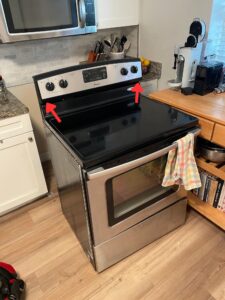
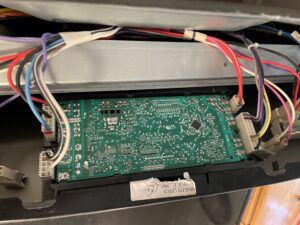
Step 1 – Remove two screws under the front control lip. On most glass-top ranges, the control panel lifts or swings forward after removing two screws under the front edge of the panel. The photo above shows exactly where these are located. Once those two screws are out, the panel gives you clear access to the components behind the knobs. Sometime there are two more screws on the back on the stove.
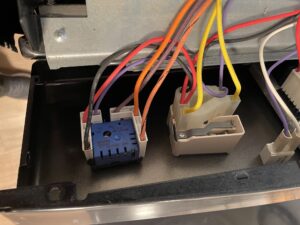
Step 2 – Locate the switch behind the affected knob. Each switch is a small rectangular component mounted directly behind its corresponding knob, with several spade terminals and wire connectors plugged in.
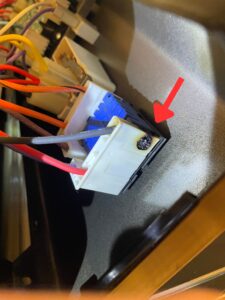
Step 3 – Look for visible burn damage. You’re looking for blackening, carbonization, or melting on the switch body or around the terminals. Check the spade connectors too, a discolored or slightly melted connector is a sign of arcing. A visibly damaged switch is a confirmed failed switch.
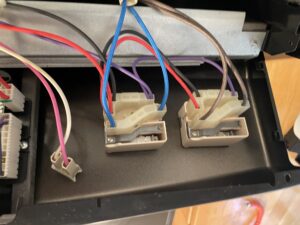
Step 4 – Check adjacent switches while you’re there. Heat spreads through the wiring harness area over time. If one switch shows burn damage, inspect the switches on either side. You may find early-stage damage on a neighboring zone that hasn’t produced symptoms yet. Replacing both at once, while the panel is already open saves you from doing this job again in a few months.
How Much Does an Infinite Switch Cost to Replace?
A replacement infinite switch costs between $20 and $40 depending on your range brand and model. You can find the correct part by searching your model number, usually printed on a label inside the door frame or behind the storage drawer, along with “infinite switch.”
Replacement takes ten to twenty minutes and requires no calibration. The connectors are keyed, meaning each wire plug is shaped to fit only one terminal on the switch. Take a photo of the wiring before you unplug anything, swap the connectors one at a time onto the new switch, and reassemble.
Compare that to the alternative: a standard service call in the Tampa Bay area runs $80–$150 before any parts. A burner element adds $40–$80. A replacement control board typically runs $150–$300 or more. If neither of those was actually the problem, you’ve spent several hundred dollars and still have a broken stove, a situation we see regularly when homeowners come to us after another provider misdiagnosed the issue. You can learn more about how we price and approach stove repairs on our stove repair service page.
When to Call a Professional Instead
This repair is well within reach for most homeowners comfortable working with appliances, provided the power is properly disconnected first.
Stop and call a qualified technician if you open the panel and find any of the following: burn damage that extends beyond the switch into the wiring harness itself, melted wire insulation, or scorch marks on the surrounding plastic. Harness damage is a more serious problem that requires professional assessment.
If you replace the infinite switch and the problem continues, the fault may genuinely lie with the control board or another component. At that point a proper diagnosis from a technician is the right move.
Tampa Bay homeowners can visit our FAQ page for common questions about repair costs and what to expect, or check our service area to see if we cover your neighborhood. If you’d rather have one of our technicians handle the diagnosis, you can also review our broader appliance repair services.We offer same-day availability across the Tampa Bay area.
Pro Tip: Don’t Stop at One Switch
If one infinite switch is burnt, treat the adjacent switches as suspects too. Heat travels along the wiring harness, and the same failure pattern often appears on neighboring zones within a few months. A thorough inspection of all switches while the panel is open is the professional approach, and it’s exactly what our technicians do on every stove and oven repair call. Control board failure is rare for these type of stoves.
Frequently Asked Questions
Can I replace an infinite switch myself? Yes, for most homeowners comfortable with basic appliance work. The connectors are keyed so they only fit one way, and no calibration is needed. The most important step is cutting power at the breaker, not just turning the knob off, before opening the panel.
How do I know if my infinite switch is bad? The clearest signs are a burner that stays on regardless of the knob position, a burner that won’t heat at all, or one that cycles erratically. Visually, a bad switch often shows blackening or burn marks around the terminals when you open the control panel.
Why did replacing the burner not fix the problem? Because the burner element itself was likely fine. The infinite switch controls the signal to the element — when the switch fails, the element either stays powered or receives no signal at all, even though it is physically undamaged.
What brands of glass-top ranges use infinite switches? Almost all major brands, including Whirlpool, GE, Frigidaire, Samsung, LG, Kenmore, and Maytag. The part number varies by model but the switch design and replacement process is very similar across brands. We repair all of these, see our brands page for the full list.
Is it worth repairing a glass-top stove or should I replace it? In most cases, a stove worth replacing a single switch on is well worth repairing. Our appliance age checker can help you figure out how old your appliance is and whether repair or replacement makes more financial sense.
The Bottom Line
A glass-top range with a stuck or non-responsive burner is one of the most misdiagnosed appliances in the average Tampa Bay home. The infinite switch, a $20–$40 part with keyed connectors and a twenty-minute replacement, is the root cause in the majority of cases. Open the panel, look at the switch, and save yourself the unnecessary service call.
If the damage is beyond a simple switch swap, or you’d rather have a certified technician handle it, Tampa Bay Appliance Fix offers same-day stove repair across the area with a free diagnostic fee applied toward your repair. Call (813) 822-5910 or contact us here.
Written by Tampa Bay Appliance Fix a local appliance repair company serving homeowners throughout the Tampa Bay area, including Tampa, Brandon, Riverview, Lithia, FishHawk and more.