A broken dryer in Tampa creates a laundry backlog fast — Florida’s year-round humidity makes air-drying impractical from May through October, and Tampa’s dense neighborhoods mean no outdoor clothesline space. Tampa Bay Appliance Fix runs same-day dryer repair routes through Hyde Park, Seminole Heights, South Tampa, Westchase, and every Tampa neighborhood, handling gas and electric models with parts stocked on every truck.
Experienced Technicians
Fast Turnaround Times
Tampa’s older neighborhoods — Seminole Heights, Hyde Park, Davis Islands — often have dryer vents that terminate under porches, through interior walls with multiple elbows, or into crawl spaces where lint accumulates unseen. Each additional bend reduces airflow and creates lint traps. A dryer running but not drying efficiently is often a vent restriction problem, not a mechanical failure. We inspect the full vent path on every Tampa dryer service call.
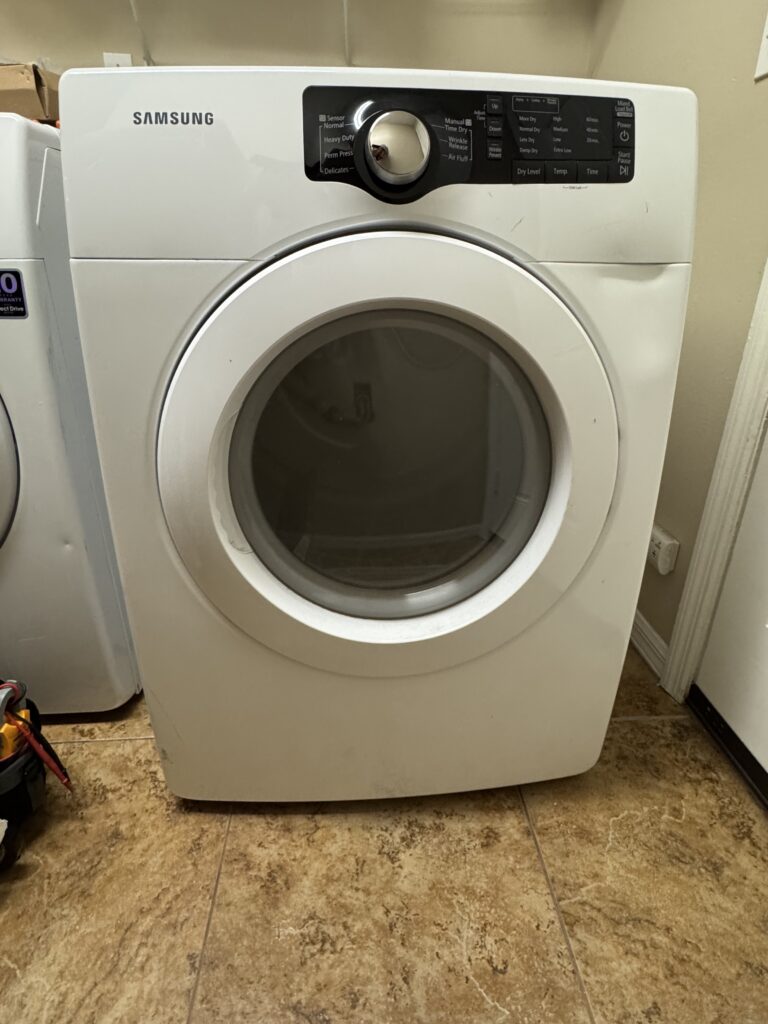
Gas and electric dryers share the same mechanical systems: motor, drum, belt, rollers, bearings, control board; but have completely different heating systems that require different training and different parts.
Electric dryer heating systems run on 240-volt circuits. The heating element, thermal fuse, cycling thermostat, and high-limit thermostat are the core components. We carry these for every brand on every truck.
Gas dryers are not common in Tampa Downtown and Seminole Heights. Heating systems involve a burner assembly with an igniter, gas valve, flame sensor, and radiant sensor. Working on gas appliances safely requires specific training. Every Tampa Bay Appliance Fix technician who handles gas dryer calls has that training. When you book, tell us it is a gas dryer so we confirm the right technician and parts for your specific model.
No, and assuming it is leads to unnecessary expense. On electric dryers the thermal fuse fails far more often than the heating element and costs a fraction of what a heating element replacement costs. On gas dryers there is no heating element at all: the igniter and gas valve coil set are where the no-heat diagnostic starts. We test the actual failed component before recommending any part.
Every 12 months minimum for average household laundry volume. Homes in South Tampa, Hyde Park, and Seminole Heights with older interior vent runs benefit from cleaning every 6 months. Households doing 6 or more loads per week should clean annually regardless of vent length. If your dryer takes more than 60 minutes to dry a standard cotton load, the vent needs inspection before diagnosing a mechanical problem.
WARNING! Your cycling thermostat has likely failed in the closed position, the heating element is running continuously with no temperature regulation. This is a fire hazard. Do not run another load! Call us the same day.
We’ll tell you immediately, give you a clear timeline, almost always one to two business days for standard parts, and book the follow-up visit before we leave. We’ll also give you honest guidance on how to protect your food in the meantime: what can stay in the fridge safely, what should go into a cooler with ice, and what to toss.
Yes. Tampa’s summer storm season produces some of the highest lightning strike density in the country. A power surge through your dryer’s 240-volt circuit can damage the main control board, the user interface board, and motor control components. If your dryer stopped working during or immediately after a storm, tell us when you call, it changes what we prioritize in the diagnostic.
Yes. If you are currently running a vented dryer in a space with no exterior vent termination that is a fire and building code issue. The correct solution for most Tampa condos is a ventless condenser or heat pump dryer. We repair both types and we can assess the venting situation and discuss options when we are there.
No. A squealling noise that appears at startup and fades as the machine warms up is a roller or idler pulley bearing that has lost its lubrication. It will not resolve itself, it will get progressively worse and eventually seize or damage the belt. Calling us now costs significantly less than calling us after it escalates.
Yes. Stackable units and laundry centers require disassembly procedures specific to each brand and configuration. When you call, tell us it is a stackable unit and give us the brand so we confirm the correct technician and tools.
Dryer not heating at all The thermal fuse is the first component we test — not the heating element, not the control board. The thermal fuse is a one-time safety device that cuts power to the heating system when the dryer overheats. It is inexpensive and it fails constantly in Tampa homes with restricted vent runs. On gas dryers the no-heat diagnostic is completely different — we check the igniter, the gas valve coils, and the flame sensor in sequence because gas dryers have no heating element. We carry components for both gas and electric heating systems on every truck and we test the actual failed part before replacing anything.
Dryer taking two or three cycles to dry a load This is one of the most expensive dryer problems Tampa homeowners have — not because the repair is expensive but because of what they are spending on electricity or gas running extra cycles without realizing the machine is failing. Tampa’s humidity makes this worse because clothes arriving in the dryer already carry more moisture than they would coming out of a dryer cycle. The cause is almost always restricted vent airflow, a heating element losing output, or a moisture sensor coated with dryer sheet residue that is misreading the load. We test all three.
Dryer stopping mid-cycle and restarting A dryer that runs for 10 to 15 minutes, shuts off, sits for a few minutes, then restarts on its own is triggering a thermal overload cutout — a safety device that kills the heating circuit when internal temperatures exceed a safe threshold. In Tampa this happens most often during summer when the laundry room itself is 85 to 90 degrees and the dryer’s cooling margins are already compressed. The machine is telling you something is wrong with airflow, thermostat cycling, or heating element output. We treat these calls as safety calls.
Dryer drum not turning The motor runs — you can hear it — but the drum stays completely still. The drive belt has broken. The belt wraps around the drum, the idler pulley, and the motor pulley in a continuous loop. When it snaps the motor spins freely and nothing moves. Belt replacements are one of the most straightforward repairs we make and we complete them in a single visit on virtually every brand and model we encounter.
Dryer making squealing or squeaking noise Squealing during the tumble cycle is almost always the drum support rollers or the idler pulley bearing wearing out. Tampa’s humidity degrades the lubrication inside these components faster than it would in a less humid environment. The rollers are what the drum rides on — when they wear down they drag instead of roll and the squealing starts. Left alone, a seized roller can put enough strain on the drive belt to snap it and enough heat on the drum shaft to damage the bearing. We replace rollers and idler pulleys as a set when either one is failing.
Dryer making thumping or banging noise A rhythmic thumping noise during the tumble cycle — one thump per drum rotation — is almost always a flat spot on a worn drum roller or a damaged drum glide strip. The drum glides are small plastic or felt pads that support the front of the drum as it rotates. When they wear down the drum starts grinding against the front bulkhead, which is both noisy and damaging to the drum edge over time. We inspect all four glides and all drum rollers on every noise complaint call.
Dryer overheating and scorching clothes A dryer that is consistently running too hot — clothes coming out extremely hot, a burning smell on fabrics, the machine triggering its own thermal cutoff — has a cycling thermostat that has failed in the closed position. The cycling thermostat is what turns the heating element on and off during normal operation to maintain temperature. When it fails closed the heating element runs continuously without cycling off. This is a fire hazard and we treat these calls as urgent. If your dryer is scorching clothes, do not run another load.
Dryer not starting When you press start and nothing happens — no tumble, no heat, no sound — the door switch is the first thing we check. The door switch signals the control board that the door is closed and it is safe to run. When it fails the machine reads the door as open regardless of what you do. Door switch replacement is one of the fastest repairs we make on a dryer call. We confirm it is the switch before quoting it.
Gas dryer igniter not firing On a gas dryer where the igniter glows but the burner never lights, the gas valve coil set has failed. The coils are electromagnetic components that hold the gas valve open while the igniter is active. When they fail the valve stays closed even when the igniter reaches ignition temperature. The igniter glows, the gas never flows, and the machine runs through the entire cycle at room temperature. We carry gas valve coil sets for every major gas dryer brand on the truck.
Dryer control panel not responding A display that is partially lit, buttons that do not register, or a touchscreen that freezes mid-cycle points to either the main control board or the user interface board — and telling which one it is without diagnostic tools is guesswork. We pull the stored error codes first. Control boards are the most expensive dryer component and replacing one on a misdiagnosis wastes significant money. We confirm the board is the actual failure before recommending it.
Dryer leaving black marks or dark streaks on clothes Dark marks on clothes coming out of the dryer are caused by a worn drum seal leaving rubber residue on fabrics, a cracked or damaged drum interior, or a foreign object lodged between the drum and the front or rear bulkhead. We inspect the complete drum interior and all seal contact points before identifying the source. Common culprits in Tampa homes: coins, underwire bra wires, small LEGO pieces, and the wire twist ties from bread bags.